All Blogs/Network
5 Aug 2026
3 min read

Types of Networks: LAN, WAN, MAN, PAN & Beyond

Types of Networks: LAN, WAN, MAN, PAN & Beyond

By: Martian Corporation

Introduction 

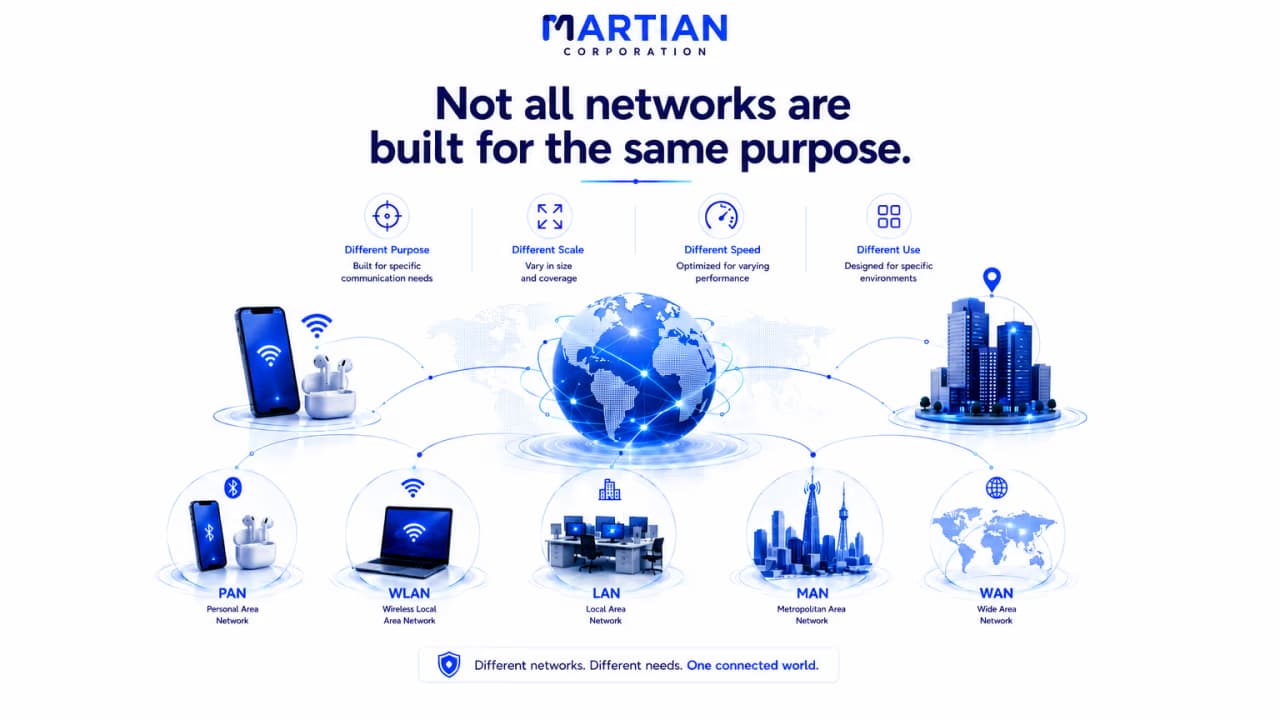
"Not all networks are built for the same purpose." 

From connecting your smartphone to wireless earbuds to linking offices across continents, different types of networks are designed to serve different communication needs. Each network varies in size, coverage, speed, and application, making it suitable for specific environments. 

Understanding these network types provides the foundation for learning how devices communicate, how businesses stay connected, and why different networking architectures exist.

Understanding Network Types 

"The right network depends on the right scale." 

Networks are generally classified based on the geographical area they cover and the number of devices they connect. 

  • PAN (Personal Area Network): Connects personal devices within a few meters, such as smartphones, smartwatches, and Bluetooth headphones.  
  • LAN (Local Area Network): Covers a limited area like homes, schools, or offices, enabling fast communication between connected devices.  
  • MAN (Metropolitan Area Network): Connects multiple LANs across a city or metropolitan region.  
  • WAN (Wide Area Network): Spans large geographical areas, connecting networks across countries or even the entire world.  
  • CAN (Campus Area Network): Connects multiple buildings within a university, corporate campus, or industrial complex.  

Each network type is designed to balance speed, coverage, and cost based on its intended use. 
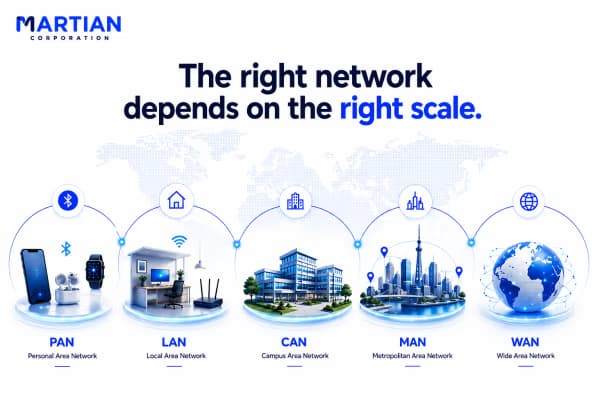
The right network depends on the right scale.

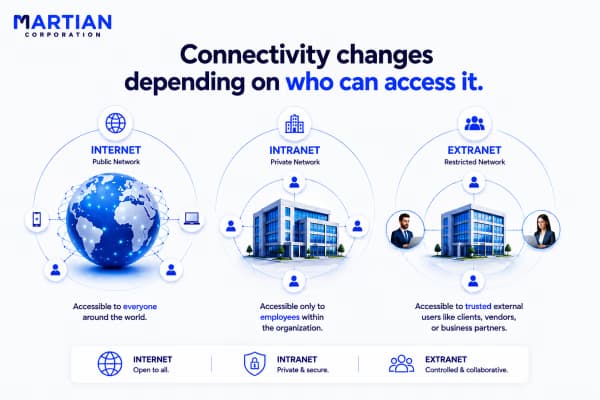
Internet, Intranet, and Extranet 

"Connectivity changes depending on who can access it." 

While network types describe coverage, networks are also classified based on accessibility. 

  1. Internet is the global public network that connects billions of devices worldwide.  
  2. Intranet is a private network used within an organization, allowing employees to securely access internal resources.  
  3. Extranet extends part of an organization's intranet to trusted external users such as clients, vendors, or business partners.  

Each serves a unique purpose while ensuring the appropriate level of accessibility and security.

Connectivity changes depending on who can access it.

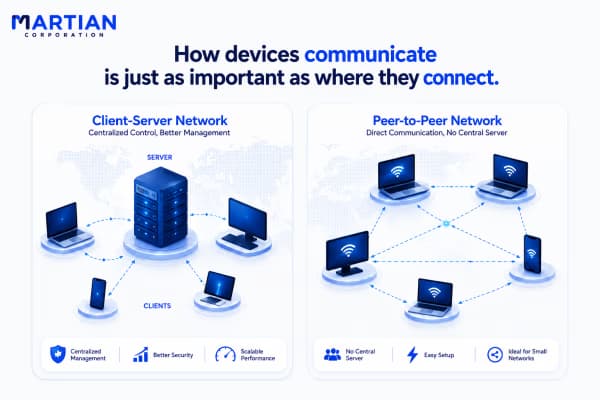
Client-Server vs Peer-to-Peer Networks 

"How devices communicate is just as important as where they connect." 

Another important way to classify networks is by their communication model. 

  • In a Client-Server Network, a central server manages resources, applications, and security, while client devices request services from it. This model is widely used in businesses because it offers better control, scalability, and data management. 
  • In a Peer-to-Peer (P2P) Network, all devices communicate directly with one another without relying on a central server. P2P networks are simple to set up and are commonly used for small networks or file sharing between devices. 

Choosing the right model depends on the size, complexity, and requirements of the network. 

How devices communicate is just as important as where they connect.

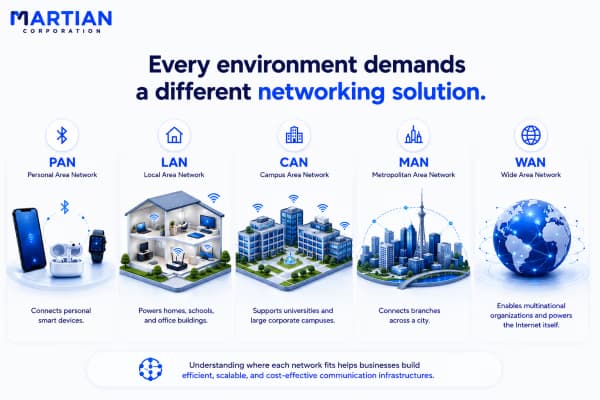
Where These Networks Are Used

"Every environment demands a different networking solution." 

Different organizations use different network types based on their operational needs. 

  • PAN connects personal smart devices.  
  • LAN powers homes, schools, and office buildings.  
  • CAN supports universities and large corporate campuses.  
  • MAN connects branches across a city.  
  • WAN enables multinational organizations and powers the Internet itself.  

Understanding where each network fits helps businesses build efficient, scalable, and cost-effective communication infrastructures.

Every environment demands a different networking solution.

Conclusion 

"Every network has a purpose, and every purpose shapes its design." 

From personal devices connected through PANs to global communication powered by WANs, each type of network plays a unique role in today's digital world. Combined with concepts like Internet, Intranet, Extranet, and communication models such as Client-Server and Peer-to-Peer, these network types form the building blocks of modern networking. 

Understanding these fundamentals creates a strong vocabulary for exploring more advanced networking concepts, including network topologies, protocols, and the OSI Model in the upcoming articles. 

NewsLetter

Stay ahead in the world of technology

Get curated technology trends, expert analysis, and product updates delivered straight to your inbox — no noise, just signal.

Enter your email address

By subscribing you agree to our Terms and Conditions and Privacy Policy

More Blogs

Why Networking Matters Today: Use Cases & Business ImpactNetwork
1 Aug 2026
3 min read

Why Networking Matters Today: Use Cases & Business Impact

Computer networking has become the foundation of the modern digital economy, connecting people, devices, and businesses like never before. From enabling cloud computing and remote collaboration to supporting cybersecurity, IoT, and enterprise operations, networks play a critical role in driving innovation and efficiency. This article explores why networking is more important than ever, highlighting its practical use cases, business impact, and the essential role it plays in powering today's interconnected world.

Read more
How Networking Evolved: The Forces That Shaped ItNetwork
29 Jul 2026
3 min read

How Networking Evolved: The Forces That Shaped It

Computer networking has evolved through decades of innovation, driven by the growing need for faster communication, reliable connectivity, and seamless information exchange. From early research networks and standardized communication protocols to cloud computing, wireless technologies, and the Internet of Things (IoT), each milestone has reshaped how people, businesses, and machines interact. This article explores the major forces that have influenced the evolution of networking, highlighting the technological breakthroughs that continue to build the foundation of our increasingly connected digital future.

Read more
From ARPANET to the Modern InternetNetwork
25 Jul 2026
3 min read

A Short History of Computer Networks: From ARPANET to the Modern Internet

The modern Internet is the result of decades of innovation, collaboration, and technological breakthroughs. Beginning with ARPANET in 1969, the evolution of computer networks introduced packet switching, TCP/IP, Ethernet, wireless communication, and the World Wide Web—transforming the way people connect, communicate, and share information across the globe. This article traces the remarkable journey of networking technologies, highlighting the milestones that shaped today's digital world and the innovations that continue to define the future of global connectivity.

Read more