All Blogs/Network
14 Aug 2026
4 min read

TCP/IP Model: The One the Internet Actually Uses

TCP/IP Model: The One the Internet Actually Uses

By: Martian Corporation

Introduction

“The OSI Model explains networking. TCP/IP is what actually runs it.”

In the previous article, we saw how networking evolved toward layered communication. That idea is formalized by models like the OSI Model and the TCP/IP Model. While OSI is widely used to understand how networking works, TCP/IP is the protocol architecture behind the Internet we use every day.

The difference matters because networking isn't just about memorizing layers. It's about understanding what actually happens when data moves from one device to another. The TCP/IP Model gives us a practical way to see that entire journey.

The Four Layers of TCP/IP

“Four layers, one job: get data from here to there.”

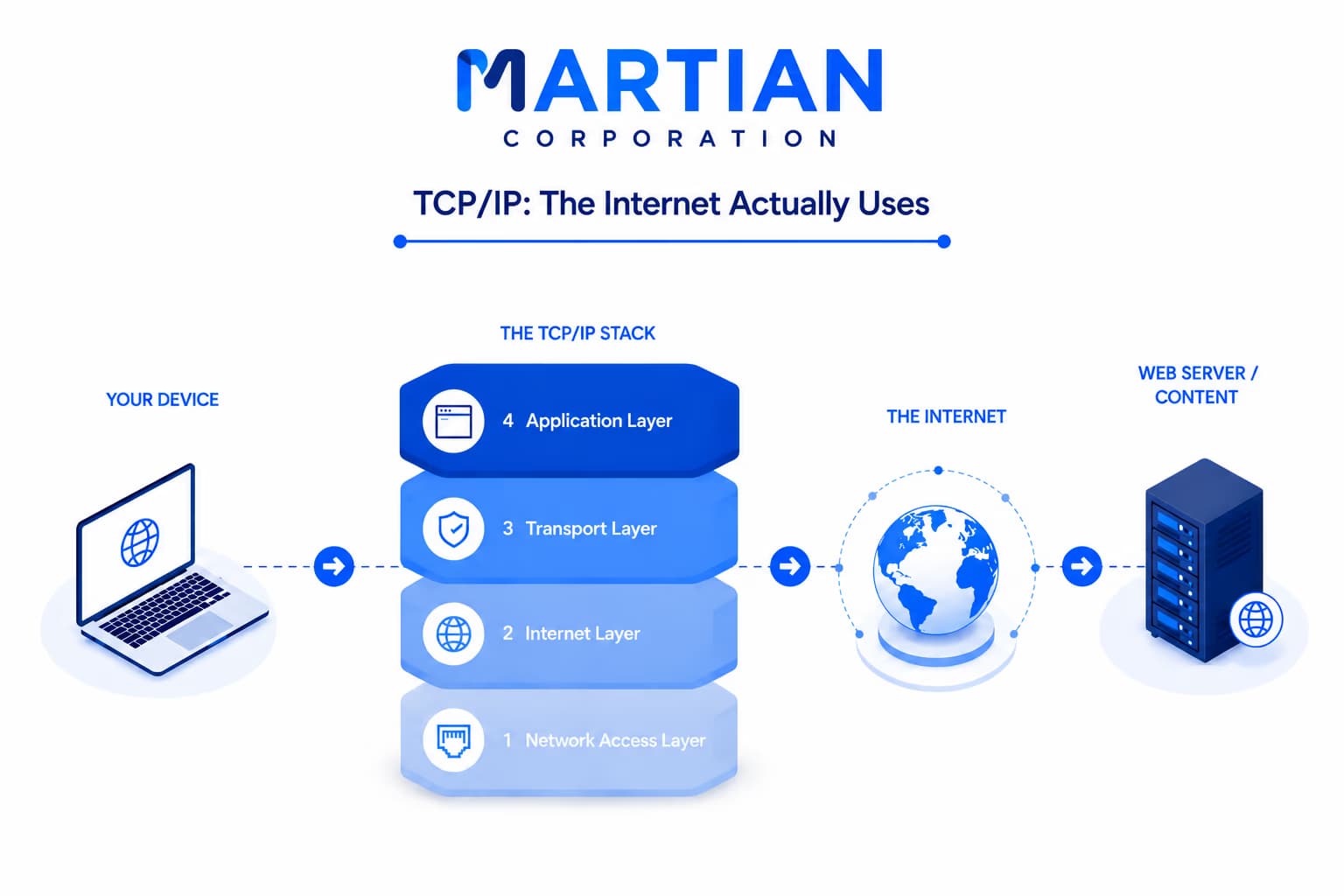
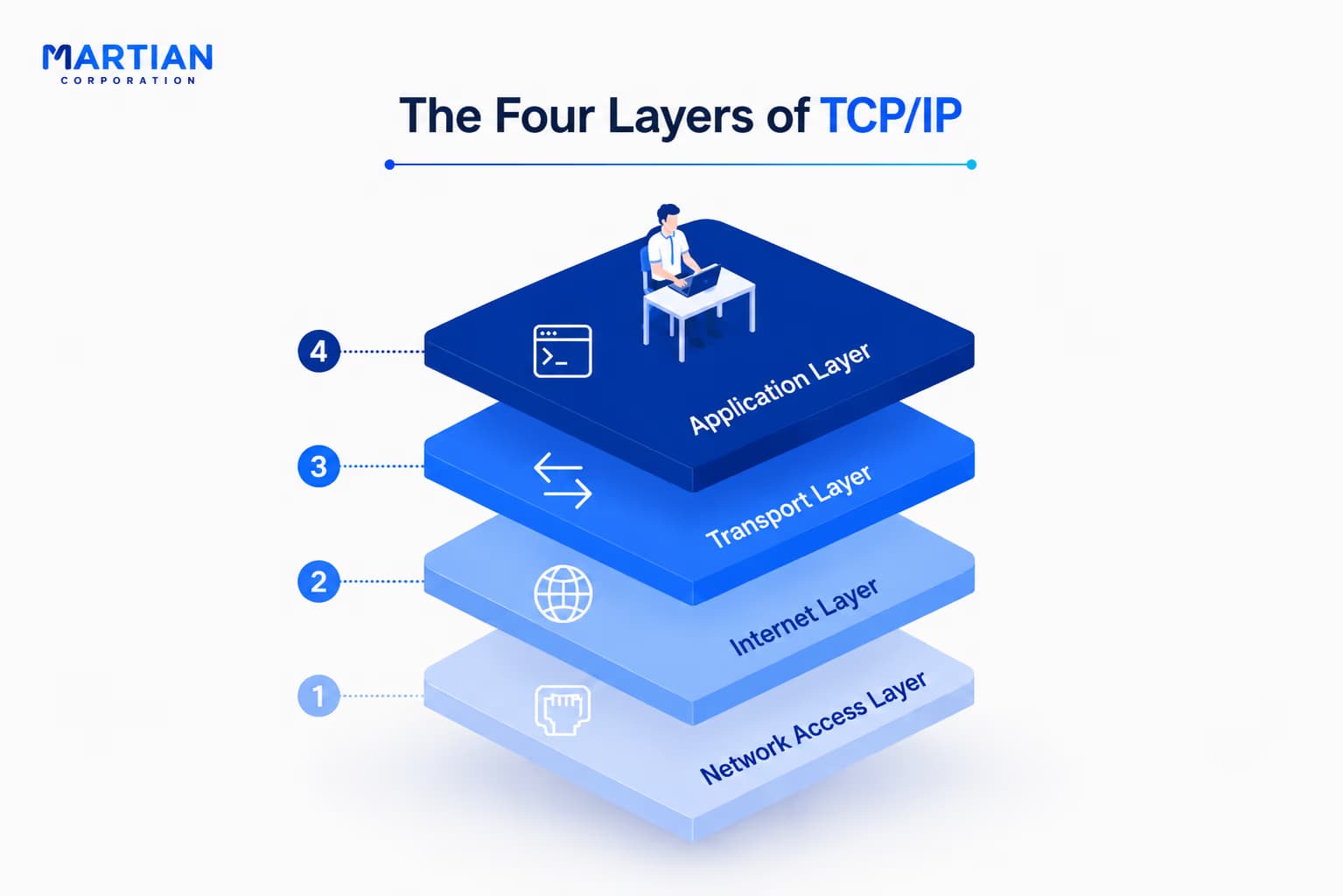
The commonly taught TCP/IP Model has four layers: Application, Transport, Internet, and Network Access. Each layer handles a different part of communication, working together to move data between applications running on different devices.

The Application Layer is where protocols such as HTTP, DNS, SMTP, and SSH operate. The Transport Layer manages communication between applications using protocols such as TCP and UDP. The Internet Layer handles IP addressing and routing, while the Network Access Layer deals with the local network technologies that actually carry the data, such as Ethernet and Wi-Fi.

You don't have to think about these layers every time you open a website. Your operating system and network stack handle them automatically. But underneath that simple click, all four are working together.
The Four Layers of TCP/IP

How Data Moves Through the Stack

“Your request travels down the layers before it ever leaves your device.”

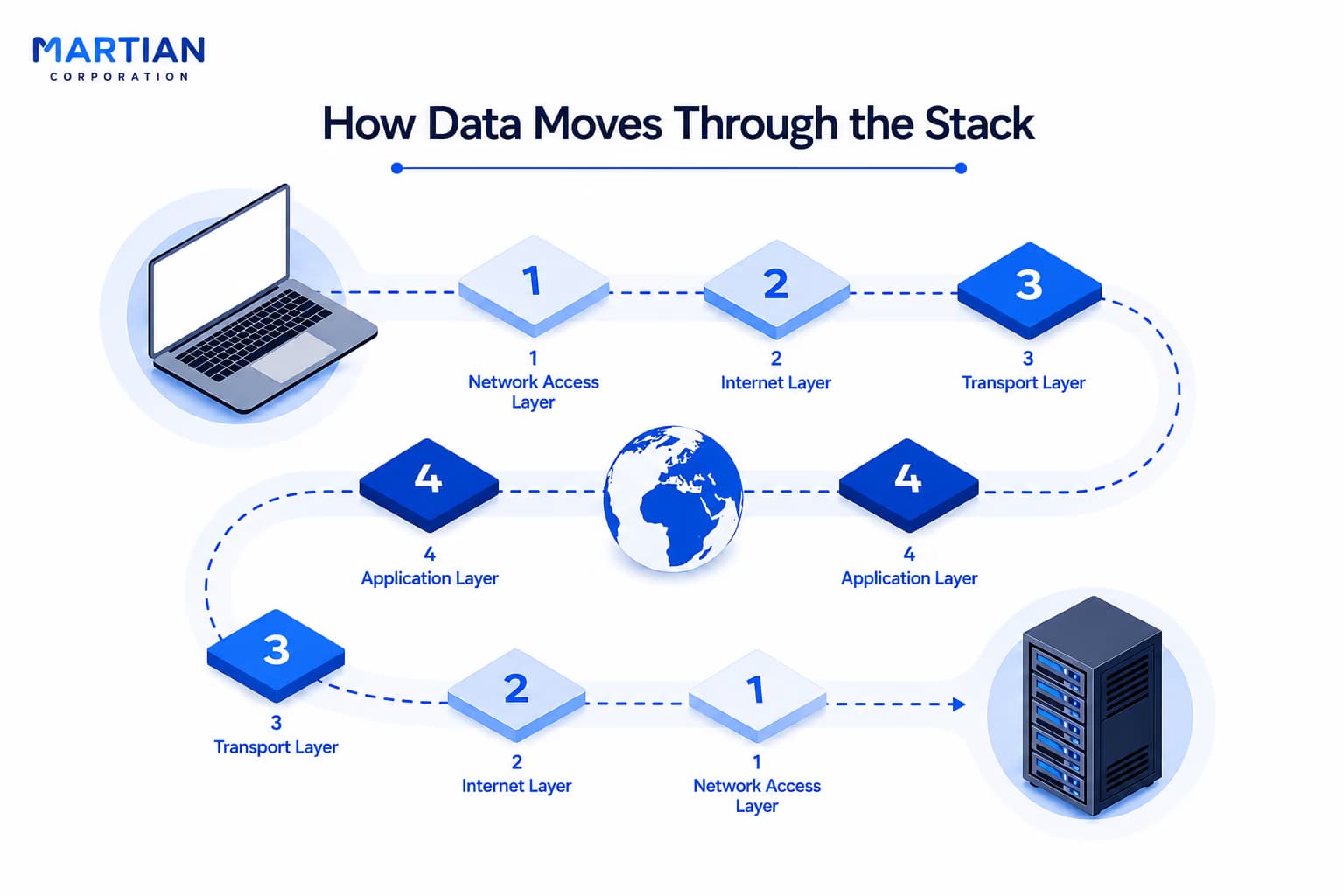
When you open a website, your browser creates an HTTP request at the Application Layer. The Transport Layer then handles how that data should be delivered, typically using TCP. The Internet Layer adds IP addressing so the data knows where it needs to go, and the Network Access Layer puts it onto your Wi-Fi or Ethernet connection.

At the destination, the process happens in reverse. The receiving device moves the data back up through the layers until the application can understand the original request.

This process of adding information as data moves down the stack is called encapsulation. Understanding it makes protocols that once seemed unrelated start to feel like parts of the same system.

How Data Moves Through the Stack

TCP/IP vs. OSI

“Seven layers became four, but the communication didn't change.”

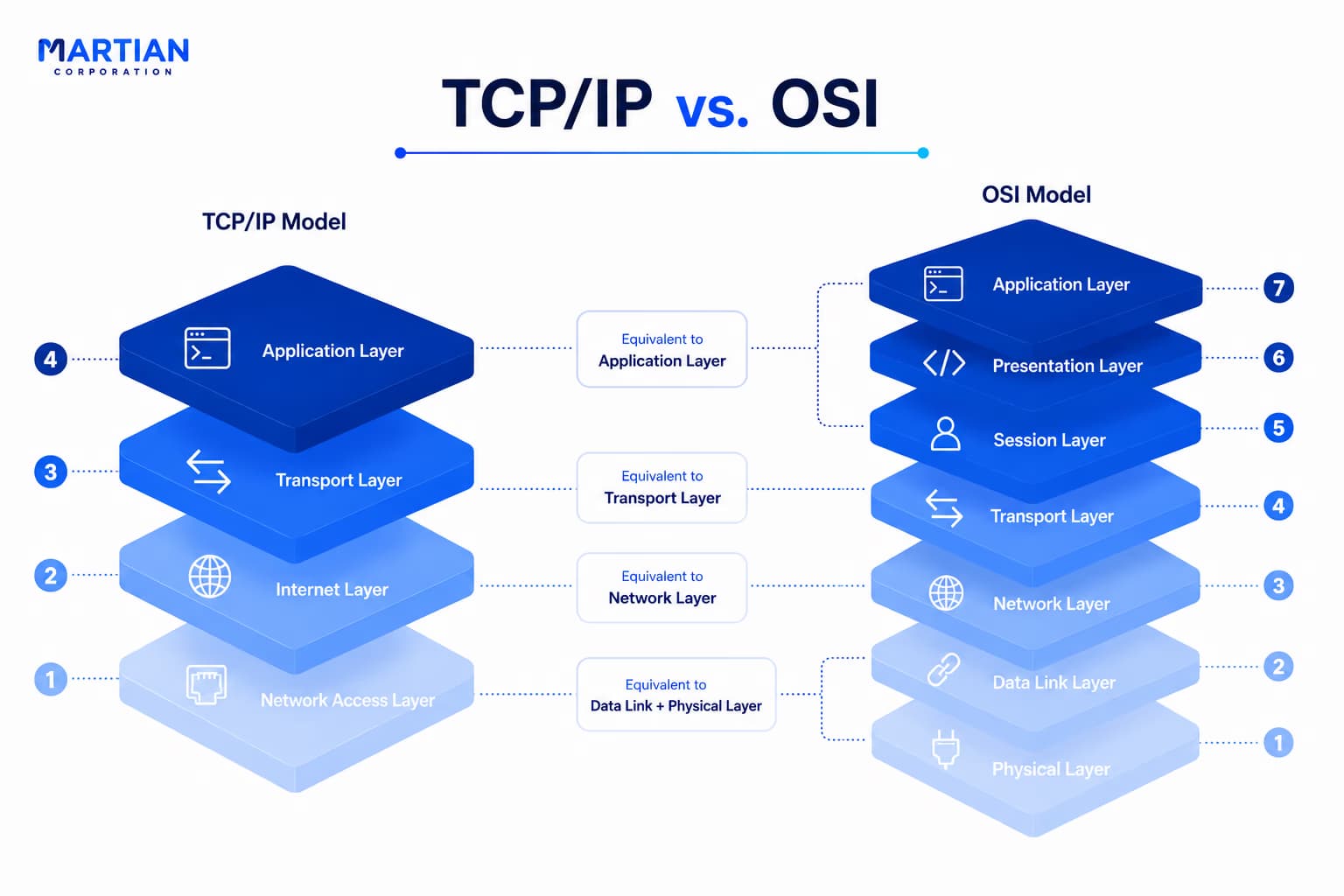
The OSI Model divides networking into seven layers: Application, Presentation, Session, Transport, Network, Data Link, and Physical. TCP/IP groups some of these responsibilities together, giving us its four broader layers.

The OSI Application, Presentation, and Session layers are generally represented by the TCP/IP Application Layer. The OSI Transport and Network layers map directly to the TCP/IP Transport and Internet layers, while the Data Link and Physical layers are combined into the Network Access Layer.

Neither model describes a completely different network. They simply organize the same communication process differently. OSI gives us a more detailed conceptual framework, while TCP/IP reflects the practical architecture used by the Internet.

TCP/IP vs. OSI

Why TCP/IP Won

“The Internet needed a common language, not a perfect diagram.”

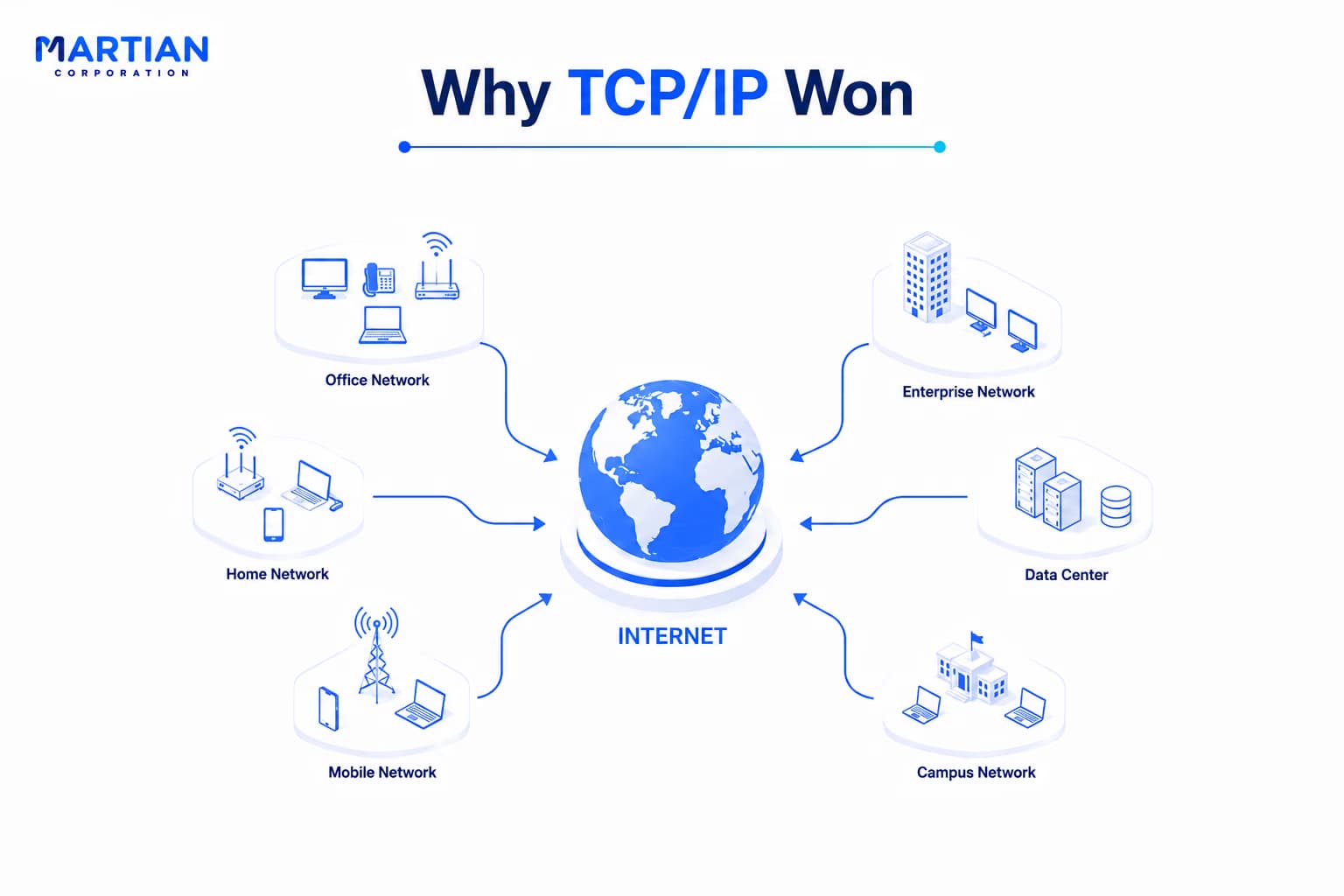
TCP/IP became dominant because it allowed different types of computers, networks, and hardware to communicate using common protocols. A device from one manufacturer could communicate with a system from another without requiring both sides to use the same hardware or proprietary technology.

That interoperability was essential for the Internet to scale. Instead of creating one network controlled by one company or technology, TCP/IP made it possible to connect many independent networks into one global system.

This is why TCP/IP is not just something you learn in a networking textbook. It is the foundation underneath the Internet, cloud infrastructure, web applications, APIs, and countless other systems we use today.

Why TCP/IP Won

Why We Still Learn the OSI Model

“The model that didn't win the Internet still won the classroom.”

If TCP/IP is what we use in practice, why is the OSI Model still everywhere?

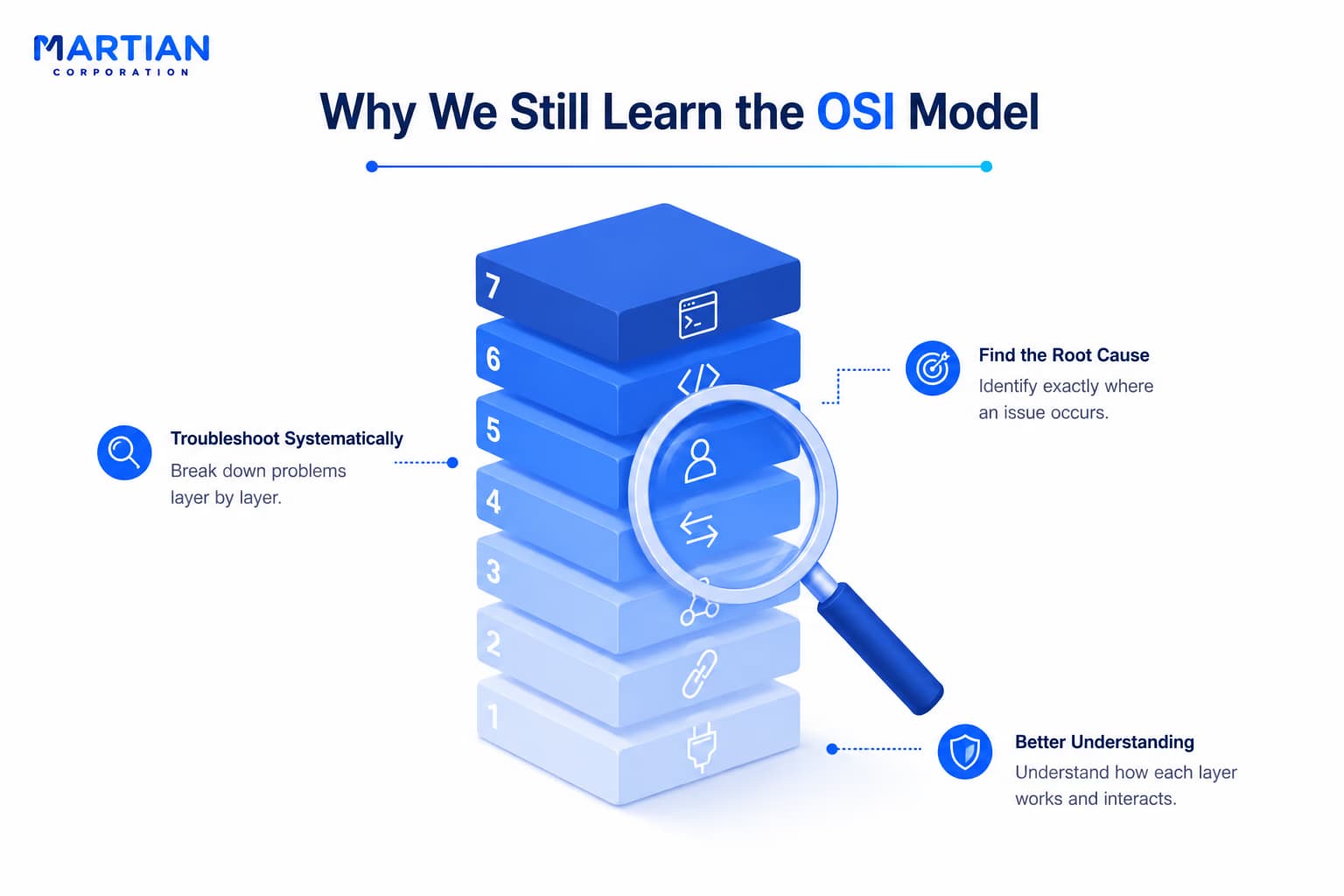
Because OSI is extremely useful for understanding and troubleshooting networks. Its seven layers give engineers a precise way to think about where a problem might exist. A broken cable points toward the Physical Layer, an addressing problem toward the Network Layer, and a failing application toward the Application Layer.

In interviews, certifications, and technical discussions, you'll often encounter both models. The important thing isn't choosing one over the other. It's understanding how they relate.

Why We Still Learn the OSI Model

Conclusion

“Learn OSI to understand the layers. Learn TCP/IP to understand the Internet.”

The TCP/IP Model turns the idea of layered networking into the practical stack that powers modern communication. Its four layers handle applications, transport, routing, and network access, working together to move data from one device to another.

The OSI Model gives us a detailed framework for thinking about that process, while TCP/IP shows how those responsibilities are organized in the real world.

Once you understand both, the layers stop being something to memorize and become a way to follow the journey of data. And the next question naturally becomes: how does that data actually find its way across a network?

NewsLetter

Stay ahead in the world of technology

Get curated technology trends, expert analysis, and product updates delivered straight to your inbox — no noise, just signal.

Enter your email address

By subscribing you agree to our Terms and Conditions and Privacy Policy

More Blogs

featured imageNetwork
7 Aug 2026
3 min read

Network Topologies & Architecture: How the Shape of a Network Defines Its Strength

Every network begins with a design. The way devices are connected—known as network topology—determines how efficiently data flows, how resilient the network is to failures, and how easily it can scale as demands grow. In this article, we'll explore the most common network topologies—Bus, Star, Ring, Mesh, and Hybrid—understand the difference between physical and logical topology, and discover how modern enterprises use three-tier campus networks and spine-leaf architecture to build fast, reliable, and scalable infrastructure. Whether you're learning Computer Networks, preparing for CCNA, or exploring network architecture and system design, this guide connects the fundamentals with real-world implementations.

Read more
Types of Networks: LAN, WAN, MAN, PAN & BeyondNetwork
5 Aug 2026
3 min read

Types of Networks: LAN, WAN, MAN, PAN & Beyond

Computer networks come in many forms, each designed to meet specific communication and connectivity needs. From Personal Area Networks (PAN) and Local Area Networks (LAN) to Metropolitan Area Networks (MAN), Wide Area Networks (WAN), and beyond, every network type plays a unique role in enabling seamless data exchange. This article explores the characteristics, applications, advantages, and real-world use cases of different network types, providing a clear understanding of how they collectively power our connected digital ecosystem.

Read more
Why Networking Matters Today: Use Cases & Business ImpactNetwork
1 Aug 2026
3 min read

Why Networking Matters Today: Use Cases & Business Impact

Computer networking has become the foundation of the modern digital economy, connecting people, devices, and businesses like never before. From enabling cloud computing and remote collaboration to supporting cybersecurity, IoT, and enterprise operations, networks play a critical role in driving innovation and efficiency. This article explores why networking is more important than ever, highlighting its practical use cases, business impact, and the essential role it plays in powering today's interconnected world.

Read more