
Introduction
“The internet was not born overnight. It was built one innovation at a time.”
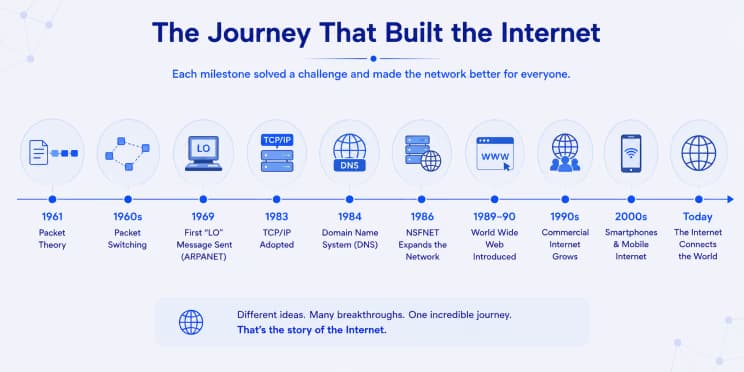
The internet is an inherent part of modern society. It surrounds us in our everyday lives, almost like electricity or roadways. However, it did not exist a mere century ago, and every webpage, search query, social media post, and digital transaction originates from concepts that have been innovated and improved over time. Specifically, the development of the modern internet involved numerous researchers attempting to address one central issue – how can computers effectively communicate over great distances?
The internet that we know and use today is a product of many small contributions that made sense individually and combined to form something extraordinary.
Where the Idea Began
“Before there was an internet, there was a question.”
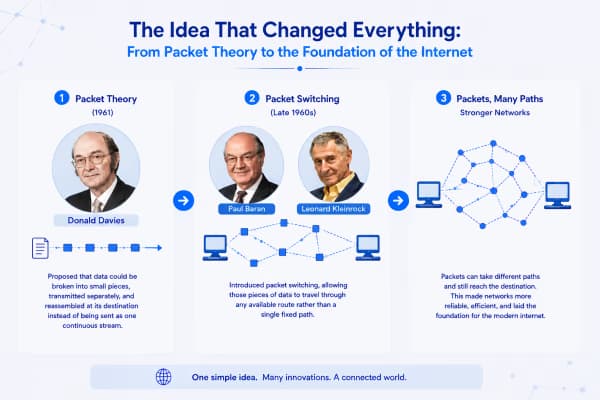
In 1961, researcher Leonard Kleinrock proposed that data could be broken into small pieces, transmitted separately, and reassembled at its destination instead of being sent as one continuous stream. A few years later, Paul Baran and Donald Davies expanded this idea by introducing packet switching, allowing those pieces of data to travel through any available route rather than a single fixed path. This made networks more reliable and efficient, and laid the foundation for the modern internet.