
All Blogs/Networking
12 Aug 2026
5 min read

The OSI Model: The Map of Everything

image-1

By: Martian Corporation

Introduction

“Every complex system needs a map, and networking’s map has seven layers.”

Right now, you can click a website and watch a response appear almost instantly. Behind that simple action, an application creates data, the device prepares it for delivery, the network finds a path, and physical signals carry it toward another machine.

The OSI Model gives us a way to see that invisible journey. Instead of treating networking as one giant process, it separates communication into seven responsibilities. That makes the system easier to understand, explain, and troubleshoot.

Seven Layers, Seven Responsibilities

“Every layer does one thing, so the whole system does everything.”

Think of the seven layers as stops on the same journey. At the top, the focus is on the information and applications a person uses. As the data moves downward, the focus gradually shifts toward delivery, addressing, local transmission, and finally the physical signals that carry the bits.

  • Layer 7, Application, provides network services closest to the user, such as web browsing and email.
  • Layer 6, Presentation, formats, translates, encrypts, and prepares data so different systems can understand it.
  • Layer 5, Session, establishes, manages, and closes communication sessions between applications.
  • Layer 4, Transport, handles end-to-end delivery through mechanisms such as TCP and UDP.
  • Layer 3, Network, provides logical addressing and routing between networks.
  • Layer 2, Data Link, handles local delivery, framing, and error detection.
  • Layer 1, Physical, carries raw bits through signals, connectors, media, and network hardware.

Memory aid: “All People Seem To Need Data Processing”
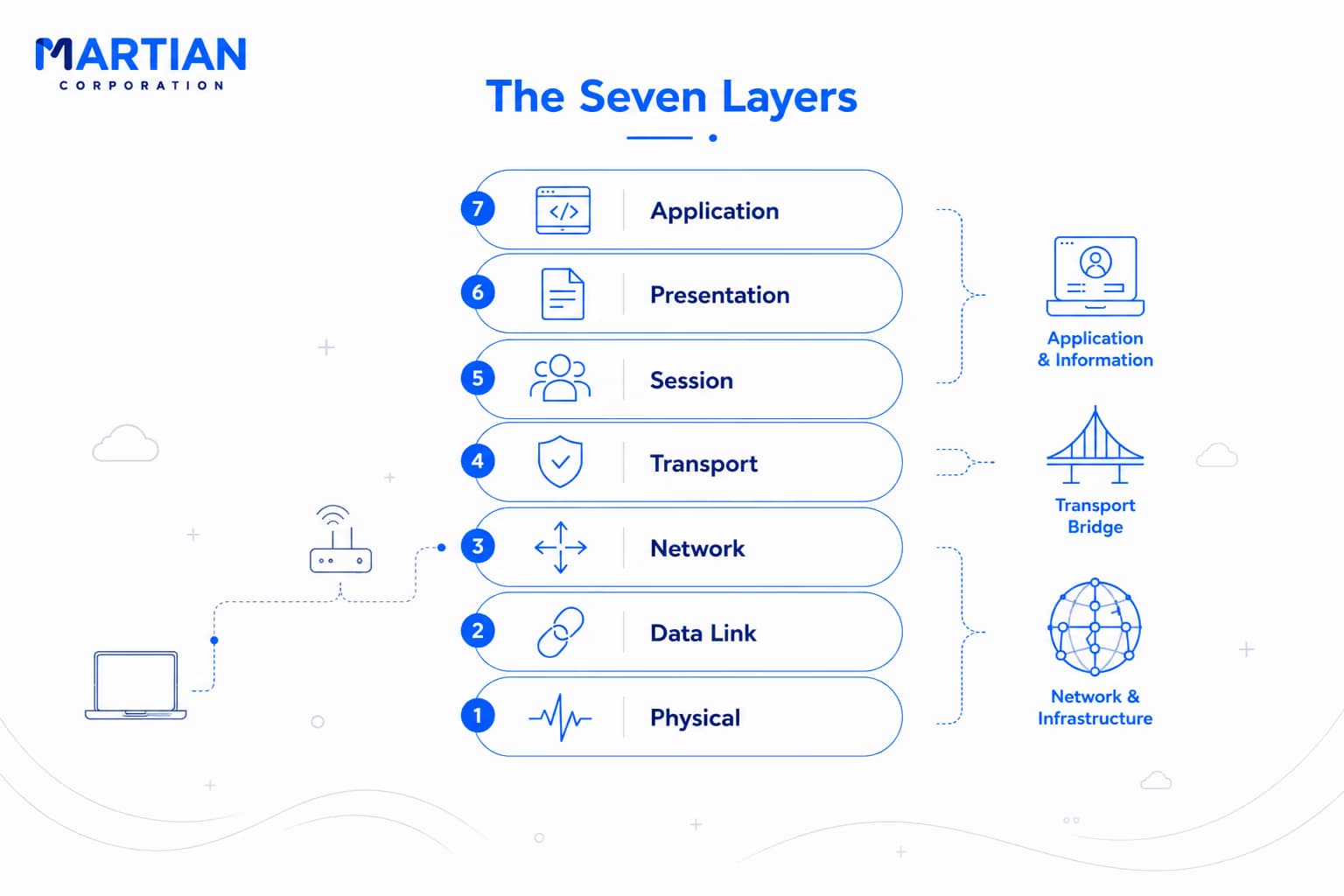
image-2

Data Gets Dressed for the Journey

“Data doesn’t just travel—it gets dressed for the journey.”

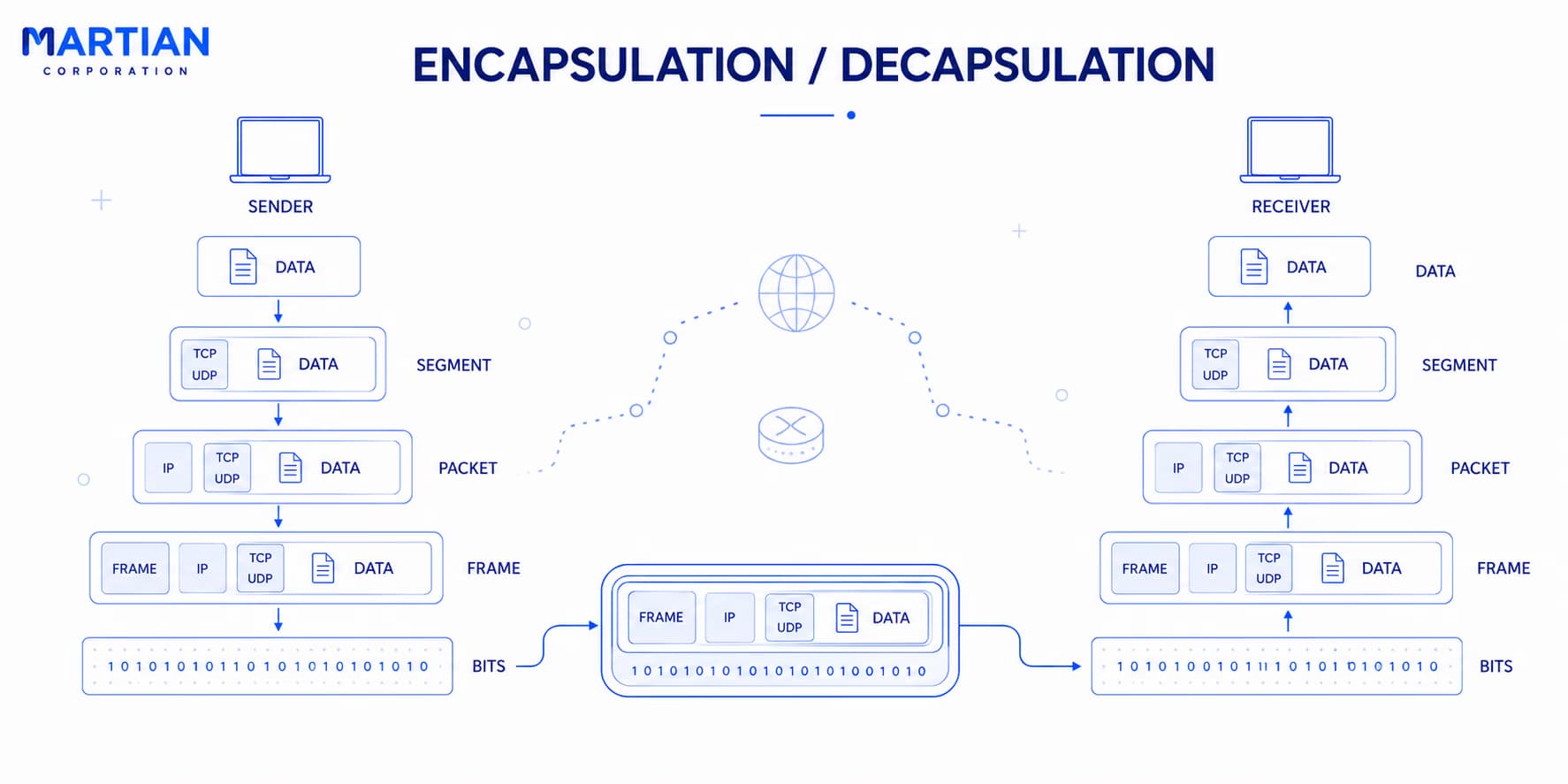
When data is sent, it moves down the OSI layers. Each layer adds the information needed for its own responsibility. This wrapping process is called encapsulation. By the time the data reaches the Physical layer, it has been prepared for transmission across the network.

Think of placing a letter inside several nested envelopes. Each envelope gives a different handler the information needed for the next part of the journey, while the original message remains inside. Networking performs the same basic idea at machine speed.

At the destination, the process reverses. Each layer examines and removes the information belonging to it as the data moves upward. This is decapsulation: the wrapped transmission is gradually unpacked until the original application data reaches the program that needs it.

image-3

OSI Explains the Network — It Doesn’t Run It

“OSI doesn’t run the Internet—it explains it.”

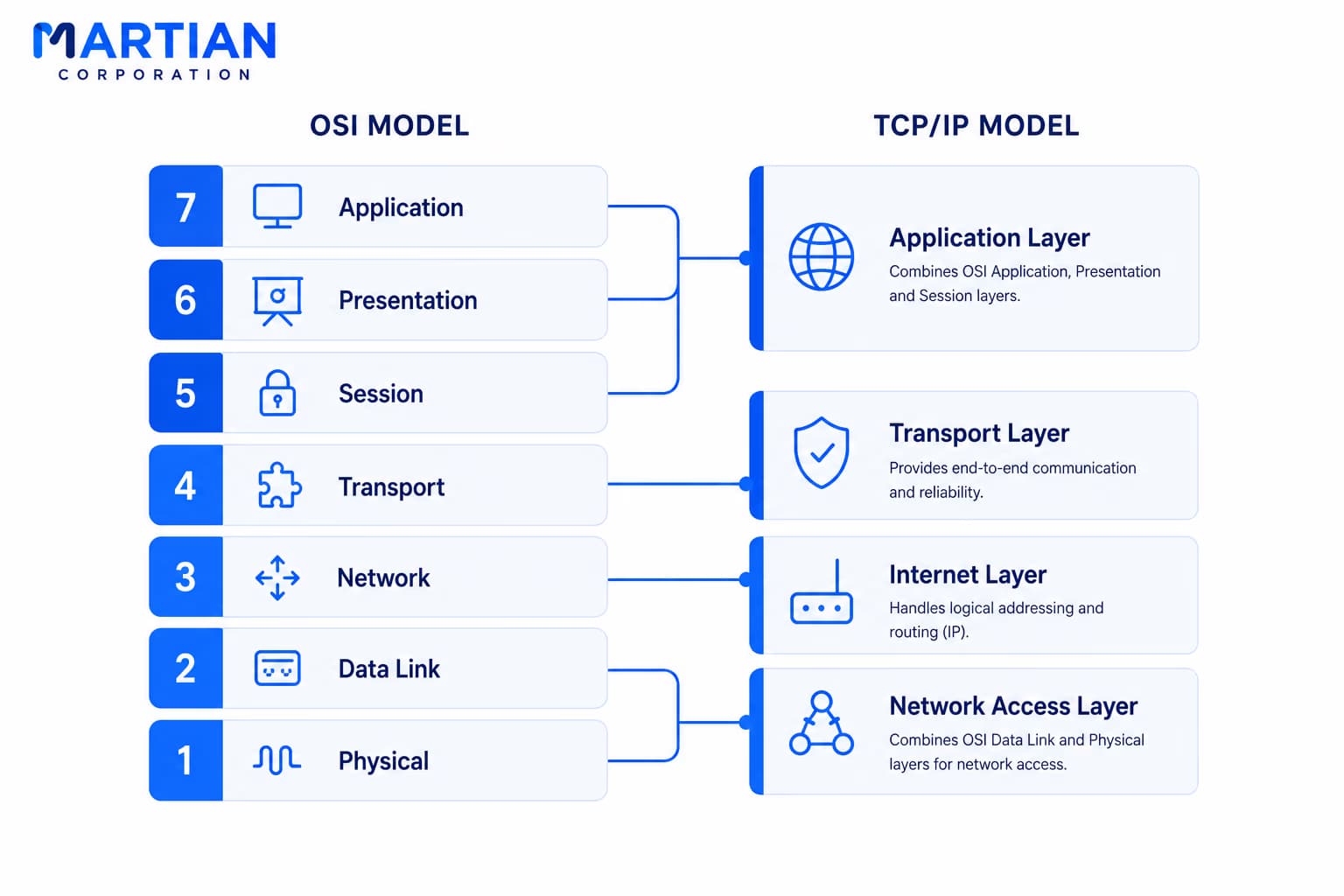
The OSI Model is a conceptual reference model, not a blueprint that every real-world network implements line by line. The Internet is commonly described through the TCP/IP model, which uses a smaller number of broader layers.

That difference does not make OSI irrelevant. Its strength is abstraction. By separating communication into clear responsibilities, it gives engineers, students, support teams, and vendors a shared language for describing where a problem occurs and what kind of technology is involved.

That shared language is why terms such as Layer 2 switching, Layer 3 routing, and Layer 4 ports remain useful. OSI gives the conversation a map, even when the real network is built from technologies that do not mirror the seven layers exactly.

Why the Map Matters

“A shared map means no one gets lost in translation.”

A network problem can sound vague when described as simply “the connection is broken.” The OSI Model gives that symptom a set of places to investigate. A damaged cable suggests Layer 1. A local delivery problem points toward Layer 2. An unreachable external network raises questions at Layer 3.

The value is not memorizing labels for their own sake. It is learning to turn a large, uncertain problem into a smaller question: which responsibility is failing? Once that question is clear, the investigation becomes more focused.

image-4

The OSI Model TROUBLESHOOTING Path

“When something breaks, the layers tell you where to look.”

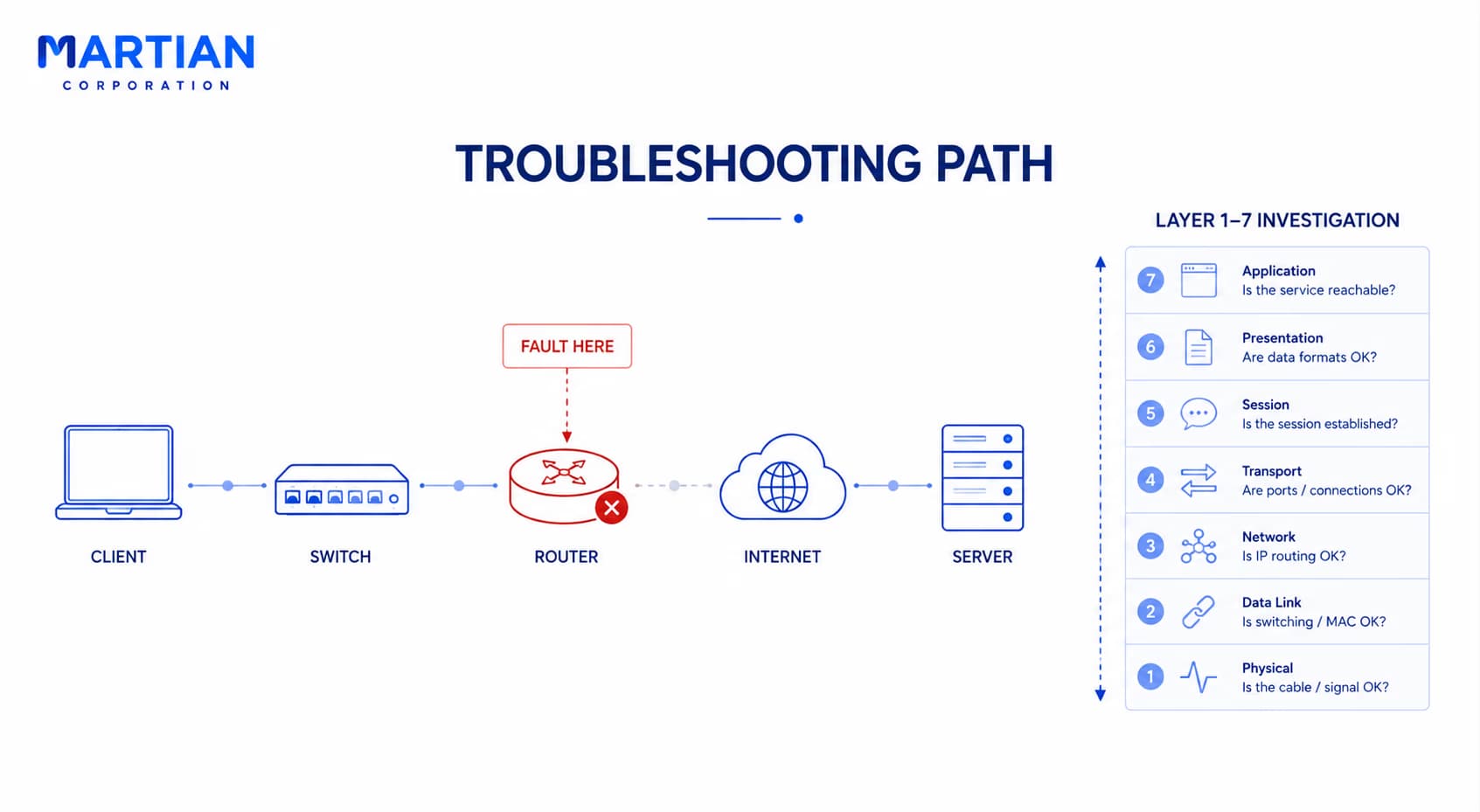
Imagine that a website will not load. It is tempting to call the whole situation a “network problem,” but the OSI Model encourages a more disciplined approach. Start with the foundation and move upward.

At Layer 1, check whether the device has a working physical or wireless connection. At Layer 2, ask whether the device can communicate across its local network. At Layer 3, investigate IP addressing and routing if the destination is outside the local network.

If the lower layers are working, move toward Layer 4 and examine transport behavior, ports, and TCP or UDP communication. Finally, if the network path is healthy but the website still fails, move upward toward Layer 7 and investigate the application or service itself.

This bottom-up approach matters because a failure at a lower layer can make everything above it appear broken. Confirming the foundation first prevents engineers from wasting time changing application settings when the real problem is a cable, link, or route.

image-5

Conclusion

“Seven layers, one language, endless clarity.”

The OSI Model is not valuable simply because it gives networking seven names. It gives a complex system a structure that people can share. Students can learn from it, engineers can troubleshoot with it, and teams can use its language to describe different parts of a network.

Once the layers become a map rather than a memorization exercise, the next question naturally follows: how does data actually find its way from one network to another? That takes us from the structure of communication to the mechanisms of addressing, routing, and packet delivery.

NewsLetter

Stay ahead in the world of technology

Get curated technology trends, expert analysis, and product updates delivered straight to your inbox — no noise, just signal.

Enter your email address

By subscribing you agree to our Terms and Conditions and Privacy Policy