
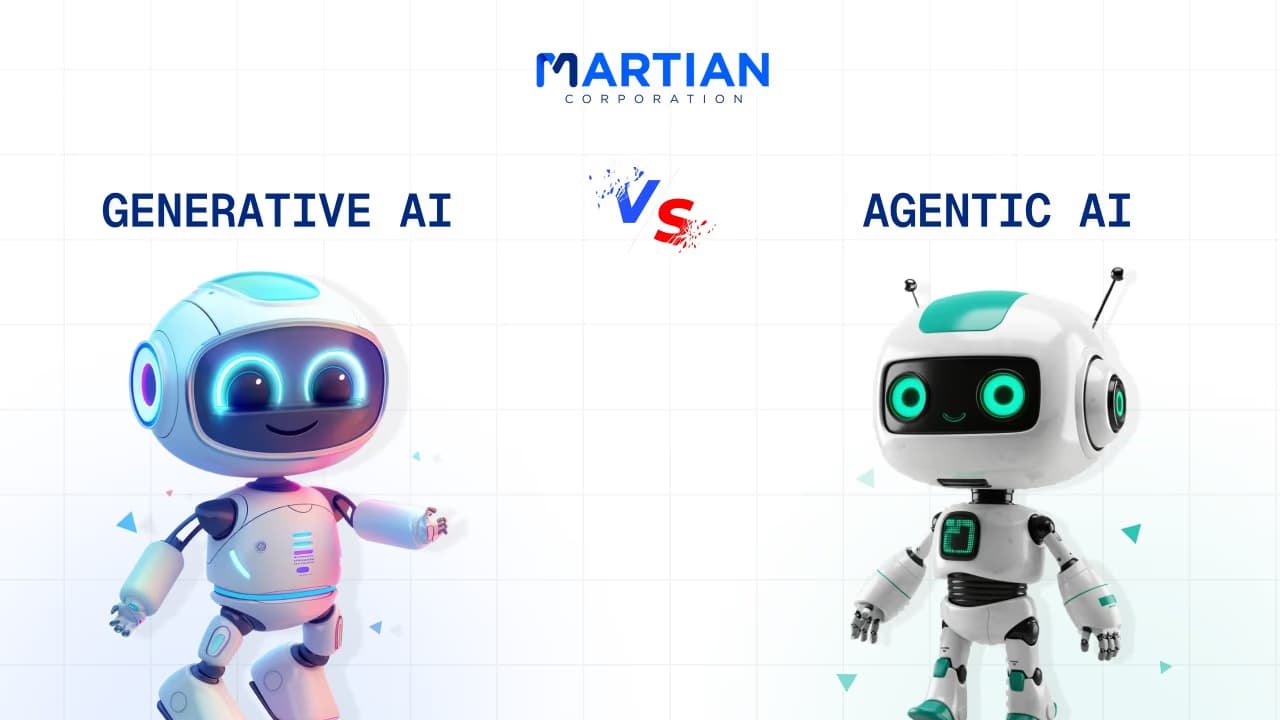
““The pace of progress in artificial intelligence is incredibly fast. Unless you have direct exposure to groups like DeepMind, you have no idea how fast—it is growing at a pace close to exponential.””
Have you ever wondered how your phone unlocks with your face, or how Netflix seems to know what you want to watch next?
That’s AI working behind the scenes!
Artificial Intelligence, or AI, represents machines that demonstrate thinking functions that approximate human behaviour and actions. By learning from experience, computers and machines acquire pattern recognition abilities, leading them to solve problems effectively, like human thinking. The magic behind modern technology automation occurs through Artificial Intelligence, which enables face recognition for phones and provides way suggestions on Google Maps and entertainment recommendations through Netflix services.
AI technology has begun transforming the daily lives of people and the way they conduct work activities. The technology exists in all our home appliances and mobile devices, transports us through our vehicles, and supports medical diagnostics in healthcare settings. The evolution of technology includes machine assistance rather than robotic invasion to achieve better and faster results. The upcoming era of AI shows tremendous promise as we begin our exploration.
What is AI? Start from the Basics :
Artificial Intelligence (AI) is a comprehensive concept that refers to any machine that can simulate human intellect. AI systems show the ability to understand language while perceiving objects, alongside making decisions through experiencing learning situations.
How Are Data Science, AI, ML, and DL Connected?
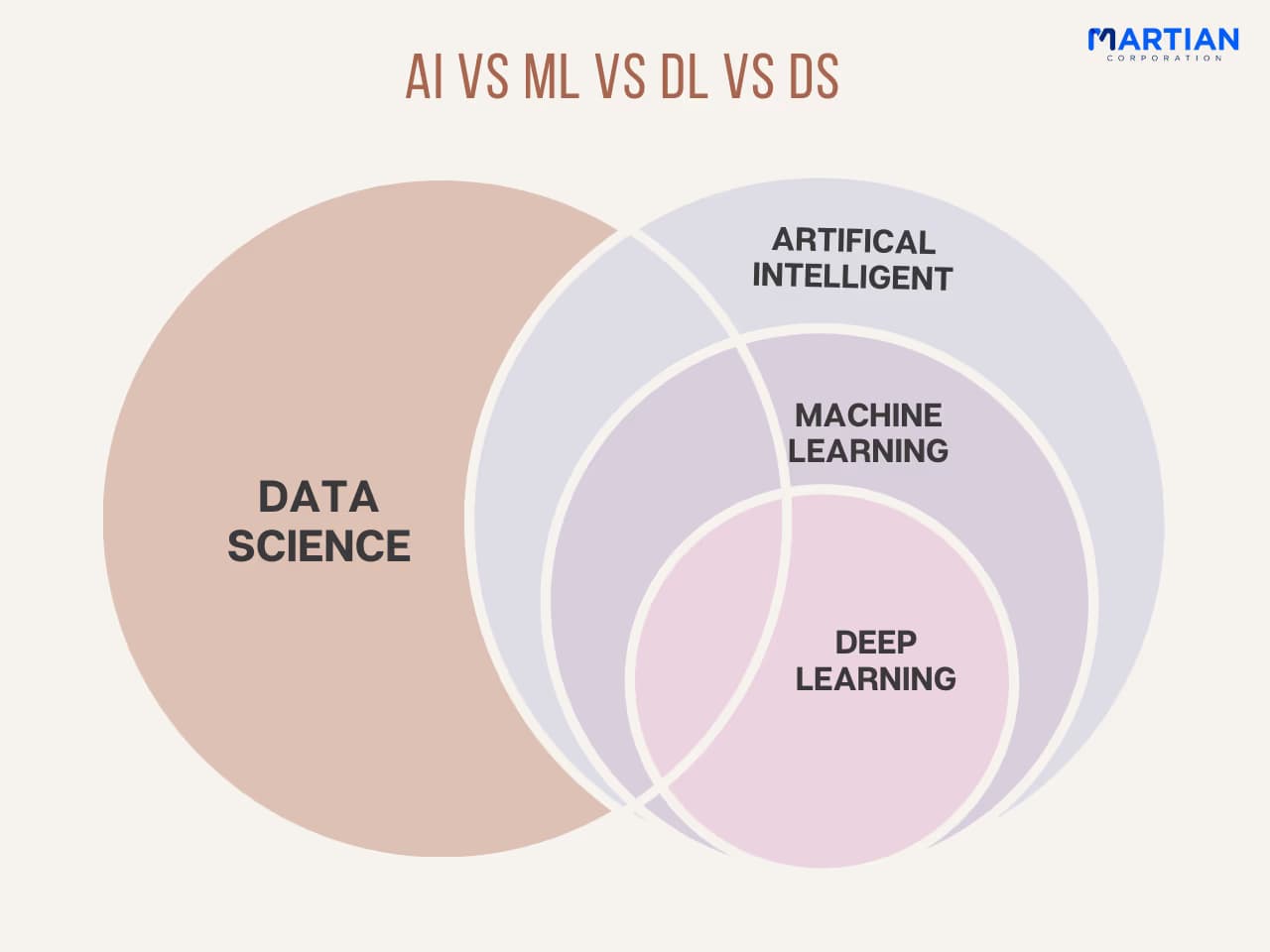
- Data Science is a broad academic domain dedicated to obtaining knowledge from information sets. It includes Artificial Intelligence (AI), Machine Learning (ML), and Deep Learning (DL) as tools for analysis. These tools stand on foundational concepts such as statistics, linear algebra, and probability, which provide a knowledge base for generating data-driven insights.
- Artificial Intelligence (AI) intersects with Data Science by contributing methods and models that enable machines to mimic human cognitive functions. AI, while not limited by Data Science, usually sets data-driven principles in action to develop intelligent systems. For example, Fraud detection systems use AI techniques, where models learn from historical transaction data to identify unusual patterns and flag suspicious activity. This synergy allows for the development of innovative, adaptive solutions across various industries.
- Machine Learning (ML) is a subset of the more extensive concept of artificial Intelligence, focusing on enabling computers to learn from data and improve their performance over time without being explicitly programmed for every task. This entails the development of algorithms that recognize patterns, predict the future, or make decisions using incoming data. ML operates through several key approaches: Supervised Learning (learning from labeled data), Unsupervised Learning (finding hidden patterns in unlabeled data), and Reinforcement Learning (learning optimal actions through trial and error based on feedback). For example, a supervised learning model can be trained on a dataset of spam and non-spam emails to classify accurately in email filtering.
- Deep Learning (DL) is a specialized subset of Machine Learning that uses multi-layered neural network architectures to handle complex problems like intelligent pattern recognition, voice recognition, understanding, and natural language processing. These deep networks can automatically learn hierarchical features from large volumes of data, making them highly effective in unstructured environments. The most common types of neural networks in Deep Learning include Artificial Neural Networks (ANNs), which are the foundational models used for general-purpose tasks; Convolutional Neural Networks (CNNs), which are particularly effective for image and spatial data analysis; and Recurrent Neural Networks (RNNs), which are well-suited for sequential data such as speech, text, or time series. For instance, CNNs are commonly used in facial recognition systems, while RNNs enable real-time language translation and voice assistants.
Types of AI Models: From Brains to Agents
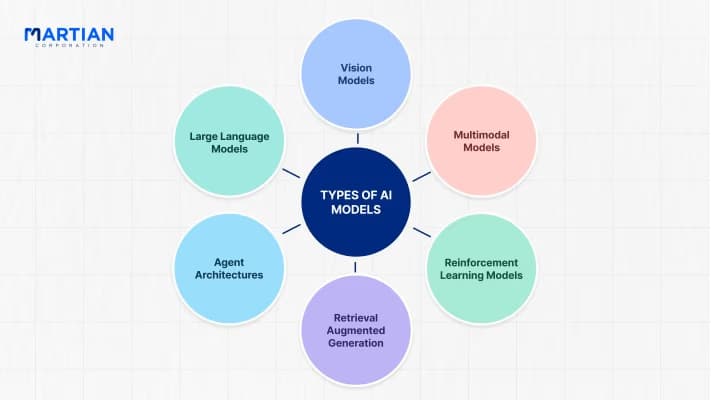
- Large Language Models (LLMs): Large Language models have been built to recognize and produce textual content that resembles human authorship. Large amounts of training text help these models acquire their ability to predict upcoming sentence words, which enables them to create sensible responses that match the context. These models operate power systems including chatbots, content generators, translators, and intelligent writing assistants. The technology interacts with us during conversations with AI tools such as earlier versions of ChatGPT and when search engines provide entire sentence answers to our inquiries. Popular examples include GPT-4, Google’s PaLM 2, Meta’s LLaMA, and Claude by Anthropic.
- Vision Models: Vision models enable machines to recognize and produce visual content, including images, moving pictures, and illustrations. The models receive training by processing labeled image collections that will allow them to identify different elements within visual materials, including scenes and facial expressions—these programs power object detection in self-driving cars and text input to art generation through digital systems. We have already witnessed their technology through smartphone AI tools that generate visual outputs from text and facial recognition. YOLO and ResNet are examples of object detection models, whereas the image generation happens through DALL·E, Midjourney, and Stable Diffusion.
- Multimodal Models: Multimodal models process distinct input varieties, including textual content, visual elements, and audiovisual files. They process multiple data formats simultaneously because they know how various formats work together, such as analyzing photos alongside generating responses. Advanced AI assistants and educational tools that require simultaneous “seeing” and “reading” benefit from these models. The multimodal models GPT-4 with vision and Google’s Gemini and OpenAI’s CLIP are the prominent examples of their kind in today's market.
- Reinforcement Learning Models: Reinforcement learning Models conduct their learning process through a testing approach that matches human and animal learning mechanisms. Their experience within environments, decision-making activities, and rewards and penalties leads to their gradual improvement. The powerful nature of these models becomes apparent when used to operate complex decision tasks within gaming systems, automation control, and physical real-world space navigation systems. AlphaGo from DeepMind defeated world champions in the game of Go, while OpenAI Five achieved a competitive performance in Dota 2.
- Retrieval-Augmented Generation (RAG): RAG models represent improved versions of basic language models through their capability to retrieve external real-time information and generate responses. Beyond their original trained material, RAG models connect with external information sources to create fresh and precise answers for users. Search-based chatbots, customer service, and research tools benefit from the unique capability of RAG models to acquire external information. The combination of live web data with GPT technology allows Bing Chat to operate as an example alongside Perplexity AI and ChatGPT when the web browsing feature is turned on.
- Agent Architectures (Meta-models): Agent architectures represent something more significant than text-generating AI models that enable reasoning plans and goal achievement behavior. Automated agents achieve complex sequences of independent operation when systems unite language models with memory, task managers, APIs, and other computational elements. These systems form the basis for self-operating AI tools that handle programming tasks while organizing information, conducting data analyses, and designing other artificial intelligence tools. AutoGPT demonstrates one AI example alongside BabyAGI, Devin (AI software engineer), and the ReAct framework from Google.
Let’s Learn about Generative AI (Gen AI)?
The artificial intelligence technology, or Generative AI, produces fresh content by learning from examples, creating texts, images, and music, and generating programming code. Through its ability to create new content, Gen AI performs differently than standard AI since it produces original outputs that resemble human creative processes. The system analyzes enormous datasets containing books, images, and code to identify patterns, which it uses to build new predictions and end products.
- How it works: Think of it this way: teaching a rather intelligent computer with millions of examples, like many stories, articles, or photos. Gradually, it picks up on how things are usually said or drawn. Therefore, when we give it a prompt like "Write a bedtime story" or "Draw a cat on Mars," it takes the style it has learned and produces something new. It does not think like a human, but has become very good at imitating how things look or sound.
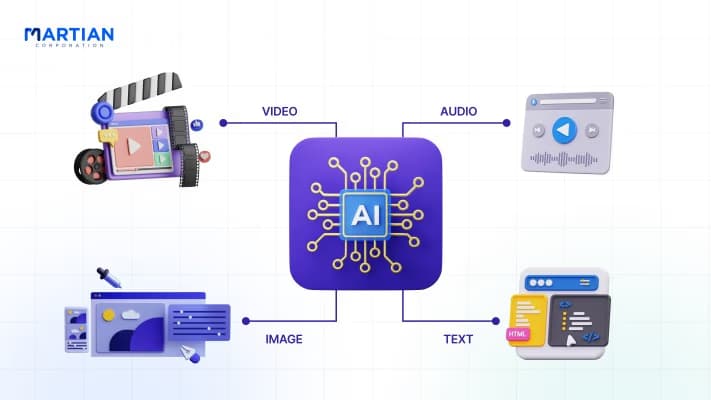
- Example:
- Text generation: ChatGPT, Google Gemini – write emails, blogs, summaries
- Image generation: DALL·E, Midjourney – create artwork or product designs
- Music generation: Suno, AIVA – compose original tunes or background scores
- Code generation: GitHub Copilot – helps developers write or fix code faster
What is Agentic AI?
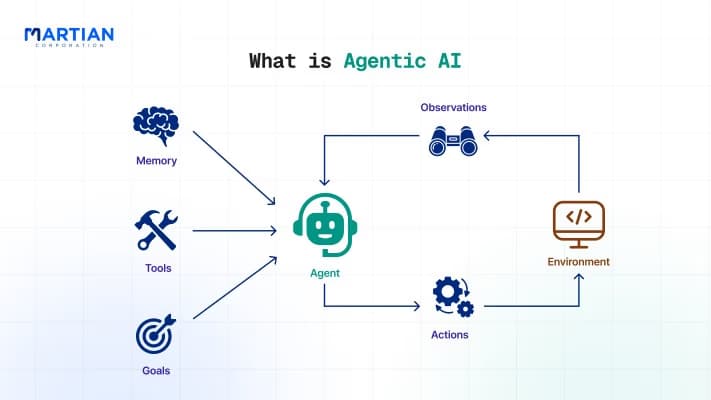
As the name suggests, Agentic AI is an artificially intelligent agent that can take action and make decisions to perform a task. There is a subtle difference in the definition: It hints at, or means, an AI upon which you set a goal or mission. The agent is instructed at a very high level to work out how to execute the task, including planning the steps, using tools, gathering information, and attempting to fulfill the goal, much like a digital assistant that thinks and acts independently.
- How it Works: The new race of agentic AI will understand our instructions (applying language models), make plan of "what to do" (such as calculate small-sized steps of larger goals), learn about what our memory recalls of past actions, and also operate tools or interact with the internet (like search engine, calculator, or code editor). Feedback learning is also used; it will seek another way if something isn't successful. Some agents even imitate trial and error to find the optimal solution.
- Example:
- AutoGPT – We must define a goal like “Research about the Semiconductor Industry and write a summary.” It searches online, reads articles, and writes a report without further help.
- BabyAGI can break an enormous task into subtasks and complete them in order.
- Devin (by Cognition) – It behaves like a software engineer who can write code, debug, and even deploy applications.
Generative AI vs Agentic AI: A Simple Comparison:
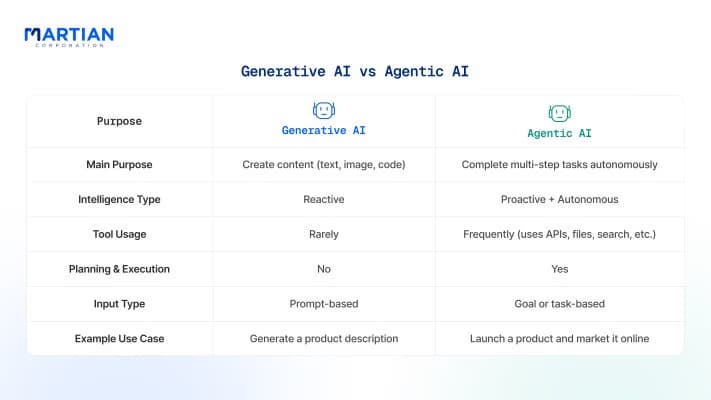
Which AI Fits Your Problem? Let’s Compare with Examples:
Problem 1: “Write a blog on Artificial Intelligence.”
- Use: Generative AI
- Why? Creative, content-focused, no planning needed.
Problem 2: “Build and launch a portfolio website for me.”
- Use: Agentic AI
- Why? Requires coding, deployment, tracking analytics, and iterations—tasks that require autonomy and action.
Problem 3: “Generate 10 product designs for my t-shirt brand.”
- Use: Generative AI
- Why? Visual generation task; no decisions or tool usage are needed.
Problem 4: “Automate customer onboarding using email, form submission, and data sync.”
- Use: Agentic AI
- Why? Multi-step workflow involving external tools and decision-making.
When to Use What? A Quick Rule of Thumb:
“You can use Generative AI when you want something created. You can use Agentic AI when you want something done.”
Where the Future Is Heading:
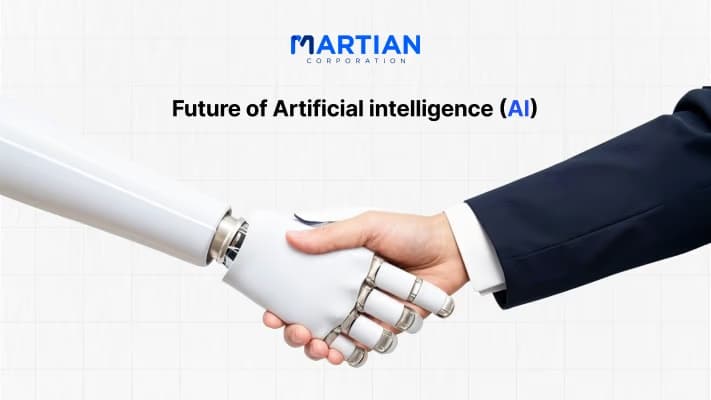
The boundaries between generative and agentic systems have begun to blur. Increasingly, Agentic AIs will sit on top of compelling generative models like GPT-4. These foundational models provide the ability to understand and generate language, while new layers of reasoning, planning, memory, and tool usage are added to enable autonomous behavior. The result is a more intelligent, capable system that doesn't simply react but takes initiative.
In the future, AI agents will work in virtual teams, with specified roles similar to those in the different departments of a company. At a more personal level, AI assistants will soon be able to handle complex tasks such as organizing schedules, responding to emails, and even aligning with your long-term goals, becoming actual cognitive partners. All in all, autonomy raises ethical issues. The more we give agents control over decisions and actions, the more urgent the need for precise regulation, accountability, and safeguards becomes. The future is not just what AI can do, but what it should do and how we ensure it does it responsibly.
Final Thoughts
The AI space is rapidly increasing its pace, from tools that enable us to write texts and images together to agents that might one day run entire businesses as an autopilot. Whether you’re a creator, a business leader, or a curious learner, understanding when to use generative AI and when to use agentic AI is a skill that will define the next generation of digital thinking.
“AI is not going to replace you. A person using AI will.”